
EWEB and BRING cook up new ways to help Eugene businesses save energy costs
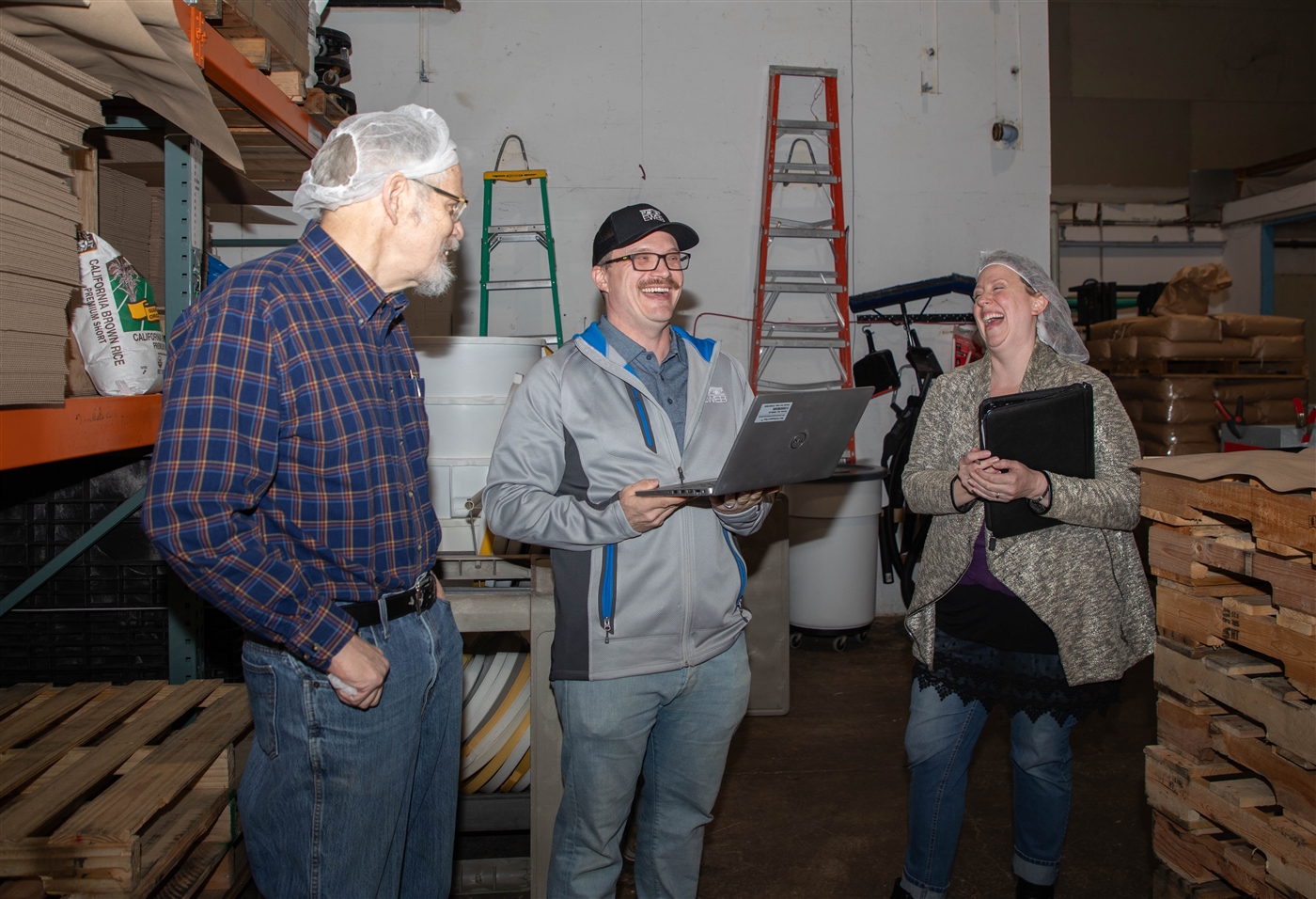
Small business owners must become multi-faceted experts to keep their companies running. They intimately understand their products or services from source to point of sale, navigating supply chains, accounting, and managing their teams along the way.
With so many factors to juggle, many small businesses don’t have the time to make their operations more sustainable.
For Shevach Lambert, President of Surata Soyfoods, sustainability has been part of his mission since 1979. By producing firm tofu and tempeh products, Surata Soyfoods is part of making the food industry more efficient.
“Right now, most soybeans are grown for animal feed, but when you do that, you lose about 80% of the protein by processing it through an animal,” Lambert explained. “Our intention is to reduce a great deal of our carbon footprint by helping people reduce their dependance on meat, and especially on beef, which has a severe impact on the environment and the water table.”
Although Lambert’s work has helped reduce externalities in the food industry, he needed help to address some of the direct impacts of his business.
When he received a call from BRING to join the Rethink Business program, Lambert jumped at the opportunity.
“They let me know about their partnership to help small businesses reduce their energy consumption and they connected us to EWEB to do a free audit of our business,” he said. “And they came in, did the audit, and we learned quite a bit about what we could afford and what we couldn't.”
The Rethink Business program has been working with Lane County businesses since 2010 to help them identify and implement sustainable practices in their workplace. BRING recently upgraded the program to include sustainability checklists that address business practices on a sector-by-sector approach.
Surata Soyfoods joined as part of a recent cohort of local food companies.
“The food and beverage manufacturing industry has its own set of challenges as it relates to sustainability,” said Emily Reynolds, BRING’s Director of Education & Outreach. “We find high energy and water consumption within those manufacturing settings, and we're able to drill down and tease out the highest-priority focus areas.”
Food businesses can improve their energy efficiency by upgrading their water heating systems to heat pump water heaters or installing reflective film to improve window insulation – both measures that Palace Coffee Bakery recently implemented thanks to participating in the Rethink Business food production cohort.
“HVAC projects are pretty popular. We do have some kitchen-specific measures such as demand-controlled ventilation,” said Eugene Water & Electric Board (EWEB) Customer Solutions Specialist Joe Hull, who performed the Energy Assessments for these businesses.
In Surata Soyfoods’ case – as well as for cohort participant Sweet Life Patisserie – Hull’s Energy Assessment revealed that improving lighting efficiency would yield significant savings.
“Once we found out we’d have a 60% reduction in our lighting costs, it seemed like a no-brainer,” Lambert said.
Hull offered solutions to replace all 54 of Surata Soyfoods’ lighting bulbs with energy efficient bulbs.
EWEB’s Commercial Lighting Rebates Program covered half the cost of the new lights.
“With our rebate helping to offset the project cost, the ROI is about a year to a year-and-a-half, so that’s a pretty attractive project, Hull said. “And on top of that, their workspace is now lit much more clearly than it was before.”
Local businesses do not have to participate in BRING’s Rethink Business program to receive an EWEB Energy Assessment. By partnering with BRING as well, though, businesses can learn about a variety of benefits beyond water and energy conservation.
“We can help businesses by taking a look at operations, facilities, equipment, looking at their products, their purchasing, as well as initiatives like hiring practices and other ways that they can retain and take care of employees,” Reynolds said. “We believe a resilient and a prepared business is a sustainable business.”
BRING is also partnering with the Green Business Engagement National Network (GBENN) and Intuit, maker of Quickbooks, to provide rebates up to $1,000 for energy efficiency and electrification upgrades to help businesses reduce costs and emissions.
Approximately 45 small businesses in Oregon will benefit from this limited-time program. Potential projects could include LED lighting upgrades, EV charging stations, and HVAC maintenance to help reduce energy consumption.
“The rebates are open to a variety of projects. So, if your business has an idea and you want to apply, we will consider all ideas,” Reynolds said.
To access these rebates, interested businesses must fill out an application detailing the efficiency project they’d like to complete. Applications close on February 28, 2025.
“I would say get in touch with BRING and learn more about it and see how, their Rethink Business program might apply to your business,” Lambert said. “I think, you know, you'll be pleasantly surprised.”
Interested businesses can learn more about the program and how to access funding here: bringrecycling.org/greenbusinessgrants.