
Energy shortfall of 9 gigawatts projected for the Northwest
If a severe cold snap strikes the Northwest during a dry year, energy shortages could lead to rolling blackouts, according to the initial results of a study published by the consulting firm Energy and Environmental Economics.
Download a fact sheet about the study.
The study was commissioned by the Public Generating Pool (PGP), a trade organization of which the Eugene Water & Electric Board (EWEB) is a member, as well as more than a dozen other Northwest utilities and power producers.
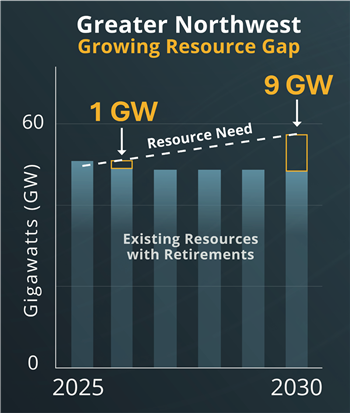
The risk is imminent. If a dry year constrains the region’s hydropower resources and an extended cold snap causes energy demand to soar, the shortfall in the Greater Northwest — a region encompassing Oregon, Washington, Idaho, Montana, Wyoming and parts of a few other states — could reach 1 gigawatt in 2026.
By 2030, the shortfall in the Greater Northwest could soar to 9 gigawatts, or roughly the electricity demand of the entire state of Oregon. In just Oregon and Washington, the projected shortfall is 5 gigawatts by 2030.
Under these conditions, a shortage could last for several days.
“There is only one way for us to prepare for and overcome this challenge, and that’s by working in partnership,” said EWEB Chief Energy Resources Officer Brian Booth, who is also the volunteer treasurer of PGP. “During those rare moments when the power system treads close to the edge of crisis, we will lean on each other. We’ll need to turn on the last-resort power plants. We’ll need to lean on partnerships with large customers to manage supply and demand. And we’ll need residential customers across the board to pare back where they can until the crisis passes.”
Rising electricity demand and an insufficient buildout of new generation has led to the gap.
Electricity demand in the Northwest is forecasted to rise 30% in the next decade, according to the 2025 Pacific Northwest Utilities Coordinating Council (PNUCC) Regional Forecast. Demand for electricity is rising as people swap their gasoline-powered cars for electric vehicles and switch their gas furnaces for electric heat pumps. But the largest driver of rapid, near-term increases in electricity demand is the growth of data centers.
As demand rises, the region has failed to build enough new power plants to keep up, creating a widening gap between electricity supply and demand. The resources that utilities across the region have built in recent years are mainly weather-dependent renewables such as wind and solar — resources can’t be counted on during extended cold snaps.
The challenge in the Northwest differs from neighboring regions. California, for instance, typically faces peaking electricity demand in the early evening hours of hot summer days, when air conditioning use soars. That demand coincides with when the sun is setting and solar generation is fading. An effective solution has been to build batteries to store abundant afternoon solar power for a few hours into the evening before temperatures cool off. With over 10 gigawatts of new battery storage built in just the last couple of years, California has largely solved their resource adequacy issues that arose in recent years.
But in the Northwest, multi-day cold snaps occur when clouds cover the sky and wind often comes to a standstill, causing renewable generation to bottom out. Wind, solar and batteries simply can’t supply enough energy to meet demand at those times. The study showed that while 4-hour batteries were a right-sized solution for California’s evening peaks, they are not cost-effective at solving the Northwest’s 100-hour cold events.
“Electrification is key to reducing carbon emissions. Any time we can replace fossil fuel use with clean electricity, that’s a good decision,” Booth said. “But we need to electrify in a smart way. That means ensuring our electric usage is flexible so that when electricity demand soars, we can pare back electricity usage temporarily. Usually, that will be a few hours. On rare occasions, such as these extended cold snaps, it will be a few days.”
Read regional media coverage of the study:
Related Programs
Our power supply
Learn more about where your electricity comes from.
Energy Supply Planning
EWEB’s energy supply planning process examines possible energy resource portfolios with a goal of creating useful insights for long-term (20-year) electricity supply planning decisions.

Understanding peak power
Managing peak electricity demand is a critical component of achieving climate recovery goals and keeping energy affordable for all customers.