
Questions?
Email our energy experts or call 541-685-7088 for more information.
In addition to the cost savings you'll get from driving an EV, you may qualify for EWEB rebates and state and federal tax credits.
Smart Charge rebates for electric vehicle public charging infrastructure
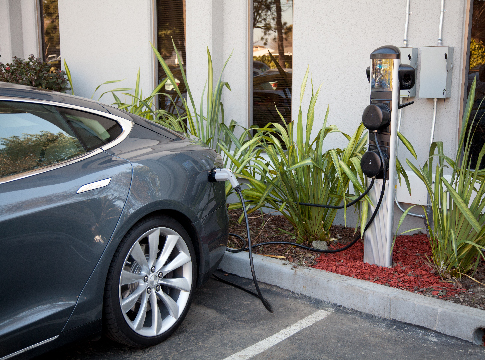
EWEB aims to expand Electric Vehicle Supply Equipment (EVSE), commonly called "charging station", in our community through our Smart Charge rebates for qualifying public charging stations.
Our rebates support the following types of stations:
Funding for this program is in part made possible by the Oregon Clean Fuels Program (CFP) administered by the Oregon Department of Environmental Quality (ODEQ).
Installing an EVSE can be highly variable in scope and costs. Visit our Charging Options page to learn more.
Steps to participate
- Start working with an electrician/contractor and determine if the current electrical service capability is sufficient or if potential upgrades are needed to support the EVSE installation. Contact EWEB Distribution Engineering at distributionengineering@eweb.org to communicate the potential addition of new load from your charging station project. The added electric load of installing EV charging stations may result in costs for upgrading facilities such as transformers, conductors, or other equipment upstream from your service. If the EWEB engineering analysis confirms that equipment must be upgraded to accommodate the added electric load, the Customer will be responsible for these charges related to upgrading the equipment, per EWEB Electrical Utility Operational Policies. This is a separate process from the commercial Smart Charge rebate program.
- Select EVSE to be installed.
- Apply online.
- An account manager will contact you to review your project.
- Receive EWEB pre-approval for your project. Pre-approval reserves funding for the proposed project.
- Install the EVSE.
- Submit EVSE spec sheets, and copies of the invoices for the qualifying EVSE (hardware and software) and installation work.
- Submit documentation of any applicable and additional grants or rebates from other entities and/or programs; the EWEB rebate is not to exceed 100% of the cost of the EVSE (hardware and software) and its installation, including any additional grants or rebates that decrease the total project cost.
- Applications and supplemental documents can be emailed to ems.answers@eweb.org.
EWEB may request a pre or post-inspection of the project to verify compliance with program requirements. The rebate check will be sent directly to the applicant 4-6 weeks after approval.
Smart Charge rebates for multifamily commercial grade level 2 public stations
As a multifamily owner, having a public level 2 electric vehicle supply equipment (EVSE) can help increase the convenience and affordability of driving electric for your tenants. Level 2 EVSE can provide 20 plus miles of driving range per hour of charging. Learn more about level 2 charging stations and developing infrastructure to charge plug-in electric vehicles. We offer the following rebates:
- New commercial grade public level 2 EVSE for multifamily housing site buildings (5 residence units or more) may qualify for a $1,500 rebate per port.
- New commercial grade level 2 EVSE for qualified multifamily affordable housing sites may be eligible for a $2,000 rebate per port.
Qualifications for Level 2 EVSE and port
- Applicant must have the authority to direct and install.
- An application must be submitted to EWEB within 120 days from the date of installation.
- Must be commercial grade EVSE; residential grade units do not qualify.
- Must be installed at the multifamily housing site address. Multifamily must be a site with 5 or more residence units. Multifamily affordable housing sites must qualify under the City of Eugene and/or State of Oregon's definition; qualification will be verified after application submittal.
- Installation site can be existing or new construction.
- Rebate is not to exceed 100% of the cost of the EVSE (hardware and software) and its installation, including any applicable and additional grants or rebates from other entities and/or programs that decrease the total project cost.
- Must be 208/240V with power output capacity of 30 amps minimum per port, and equipped with the SAE J1772 or NACS connector plug.
- In the case of a multiple-port EVSE, the rebate can apply to each port only if users charge simultaneously at full capacity (30 amps minimum) on each port . If charging capacity is reduced when multiple ports are in use, the additional rebate does not apply per port.
- Must be network-connected capable and demand response capable. EVSE network must be Open Charge Point Protocol (OCPP) compliant, and adhere to the Open Automated Demand Response (Open ADR) standard.
- Must be certified and listed under a Nationally Recognized Testing Laboratory, including Underwriters Laboratories (UL) or Electrical Testing Laboratories (ETL).
- Installation must be permitted, inspected, and approved in compliance with the National Electric Code along with local, county and state requirements. It is the customer's responsibility to ensure the installation is done in compliance with applicable codes. Installations should be performed by a licensed electrician.
- Resold, rebuilt, received from warranty insurance claims, third party-owned, or awarded as a prize or grant, are not eligible for rebates under this program.
- Parking spaces should be marked and reserved for active plug-in electric vehicle (POV) charging only.
- Features and technologies that help users monitor its utilization and location should be implemented.
Clean Fuels Program
Entities providing public charging, including workplace, fleet, business and multifamily may qualify for additional revenue generation through the Oregon Department of Environmental Quality Clean Fuels Program. The program allows EVSE operators to generate Clean Fuels credits, which can then be monetized. This is not an EWEB program. Visit DEQ's Clean Fuels Program website or contact OregonCleanFuels@deq.state.or.us to learn more.
Oregon Clean Vehicle Rebate Program
The Oregon Department of Environmental Quality's Oregon Clean Vehicle and Charge Ahead Rebate programs can save Oregonians up to $7,500 on the purchase or lease of a qualifying electric vehicle. All Oregonians can receive up to $2,500 for the purchase or lease of a qualifying new EV. Low and moderate income Oregonians can save an additional $5,000 on qualifying new or used EVs. For the Standard Rebate, vehicles must have been purchased or leased between May 22, 2025, through September 8, 2025. For the Charge Ahead Rebate, vehicles must have been purchased or leased between May 22, 2025, through December 4, 2025. Applicants still have six months from the purchase or lease date to apply for rebates. Learn more and download an application on DEQ's website.
If you are purchasing or leasing your car from a dealer, you may be able to receive your rebate at the time of purchase. DEQ has developed an interactive map to locate dealerships with this arrangement in place.
Community Charging Rebates
The Oregon Department of Transportation's Community Charging Rebates Program, helping to fund Level 2 electric vehicle projects in Oregon's communities, opens its next funding round on November 6, 2025, and closes on January 20, 2026, at 5 p.m. ODOT plans to release another round of federally funded Community Charging Rebates later this year.
The rebate program reimburses some of the project costs of buying and installing Level 2 EV charging stations at multifamily homes, workplaces, and publicly accessible parking areas. The rebates are $8,000 per Level 2 charging port or up to 80% of eligible project costs, whichever is less.
Visit the Community Charging Rebates Program webpage for more information, including guidelines, webinars, qualifications, application details, and timelines for additional rounds of funding.
Community Charging Rebates can be stacked EWEB EV charging infrastructure rebates.
Federal tax credit
The federal government offers the New Clean Vehicle Credit (up to $7,500), Previously-Owned Clean Vehicle Credit (up to $4,000), and Qualified Commercial Clean Vehicle Credit for vehicles acquired on or before September 30, 2025. Visit the Clean Vehicle Tax Credits webpage for more information.
In addition, home or business installations of electric vehicle charging stations can receive additional tax credits, including up to $1,000 per station for homeowners. Visit the Alternative Fuel Vehicle Refueling Property Credit webpage to learn more.
Related Programs

Rebates and loans
We offer rebates and loans to help your business save money through energy and water efficiency.
Solar electric program
Our solar electric program allows you to produce clean, renewable power at your business while also helping us decrease the amount of power we purchase from non-renewable sources.